Méridien · Architecture, read as data
This buildingis a kilobyte.
The Museum of the Future is the most photographed building in Dubai. It is also a dataset: a structure grown by an algorithm from 2,400 steel members, wrapped in a facade of exactly 1,024 panels (two to the tenth power), with windows that are sentences. Scroll to take it apart.
Take it apart
STEEL MEMBERS GROWN0 / 2,400
MUSEUM OF THE FUTURE · DUBAI · OPENED 22.02.2022 · MODEL: SCHEMATIC DIAGRID, NOT ENGINEERING DATA
Blueprint 01 · The torus
A ring with no columns inside
Seventy-seven metres tall, 30,548 square metres of floor, and not a single interior column. The Museum of the Future opened on 22.02.2022, a date picked as deliberately as everything else here, and was billed as the most beautiful building on Earth.1
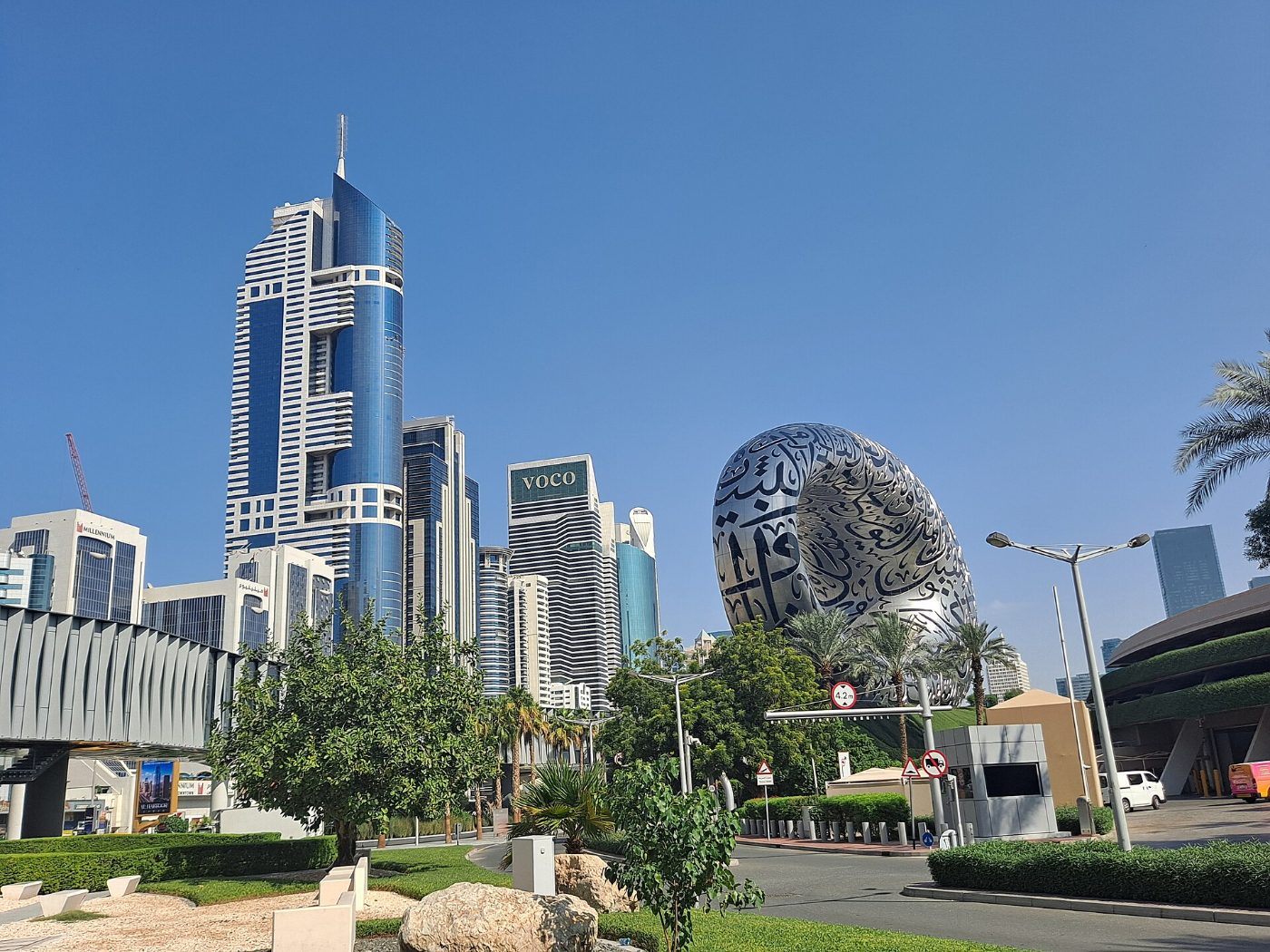
The form is a torus stood on its rim: a solid ring of exhibitions around an elliptical void. In the official reading, the building is the future we know how to imagine and the hole is the future we do not: the museum's best exhibit is the part it left out.4
Holding that shape up without columns is the hard part. The load has to travel around the ring through the skin itself, which is why the skin is not decoration: it is the structure.
2,400
Blueprint 02 · The algorithm
The shape no engineer would draw
The diagrid, the web of steel that lets the torus stand hollow, was not drawn by hand. Buro Happold wrote a growth algorithm that generated configurations, tested them and kept what worked.2
How a diagrid grows
01 · seed
02 · propagate
03 · densify
04 · close
The problem was too big for manual iteration: thousands of members, each affecting the load path of the rest, on a doubly-curved surface with a hole in it. The engineers describe the process as growing the structure rather than designing it: the algorithm added steel where the forces asked for it, and the final geometry is the one that survived.2
The result reads as ornament and works as skeleton. Every intersection you see on the facade is a real joint doing real work.
Blueprint 03 · The kilobyte
Count the panels
The facade is 17,600 square metres of composite, cut into exactly 1,024 panels, two to the tenth power. A building about the digital future, clad in a kilobyte.3
1,024 panels, one per cell
32 × 32 = 1,024 — the whole facade as a grid
PANELS PLACED0 / 1,024
No two panels are alike. Each is a four-layer composite of fibreglass and stainless steel, robotically formed in a process of more than sixteen operations, and each has one address on the torus where it fits.3
Fitting the kilobyte onto the building took eighteen months.
Blueprint 04 · The text
The windows are sentences
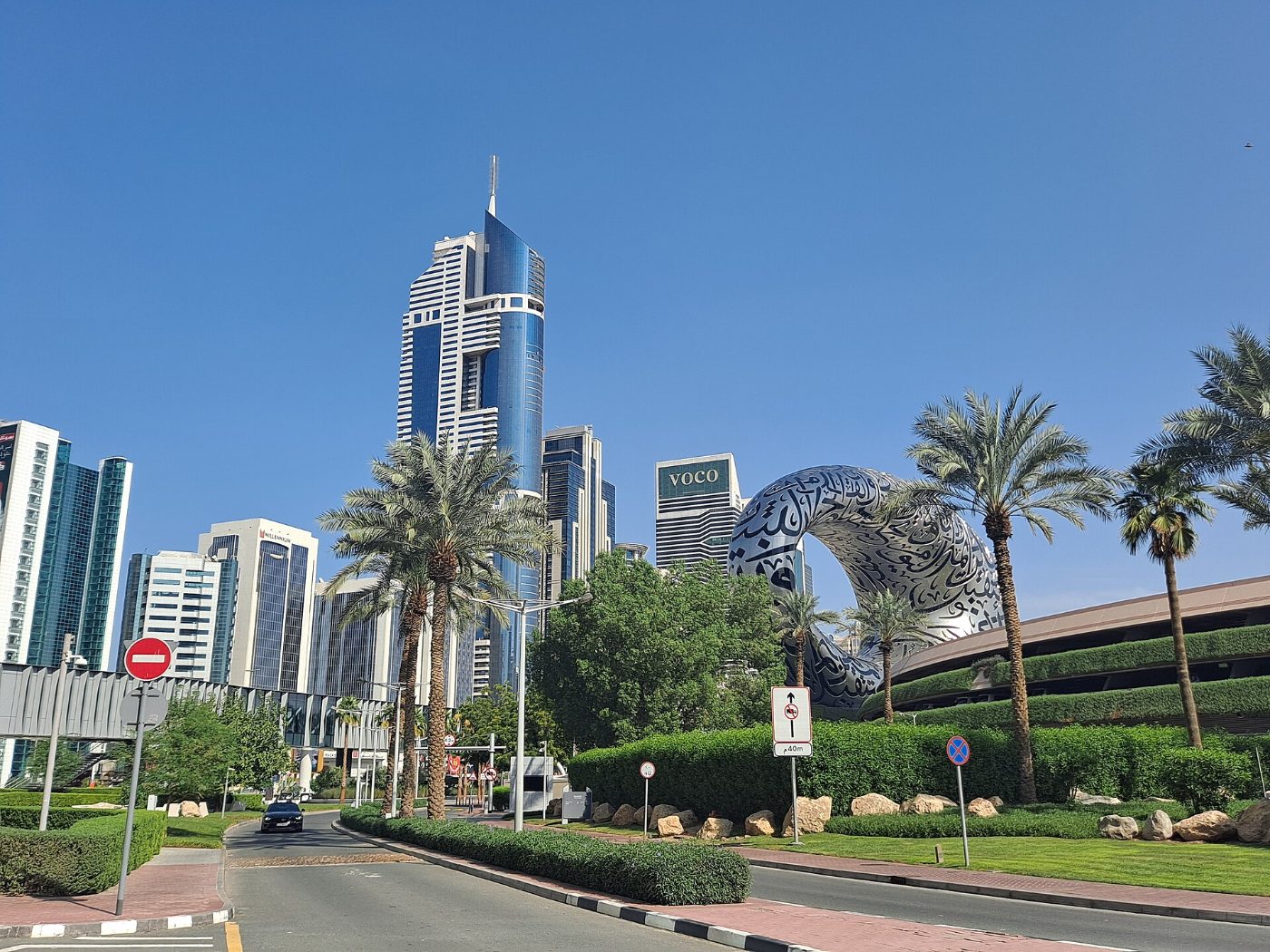
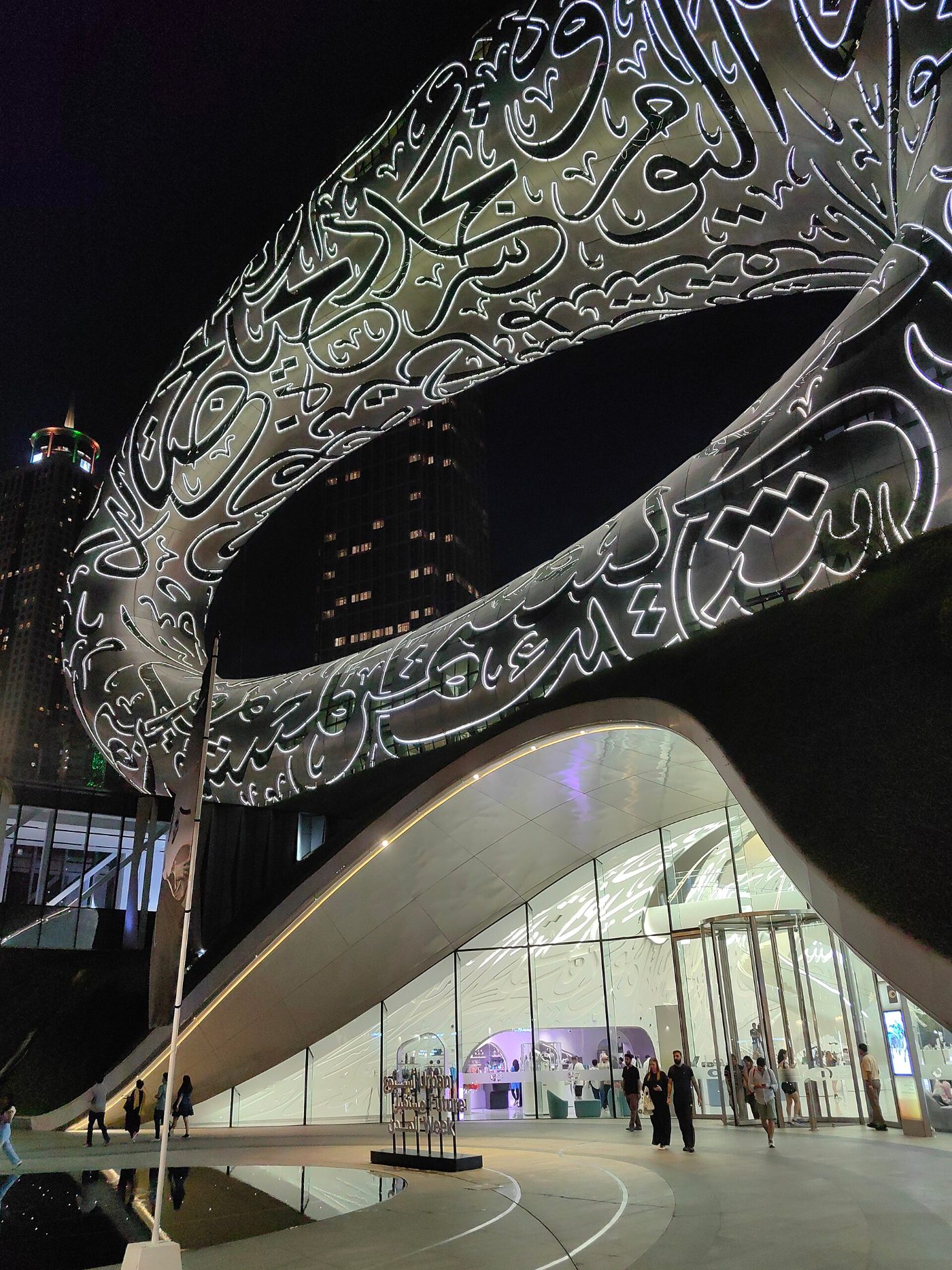
There are no ordinary windows. The glazing follows three quotations by Sheikh Mohammed bin Rashid, drawn in Thuluth calligraphy by the artist Mattar bin Lahej: about 14 kilometres of line, if you pulled it straight.4
- 01
The future belongs to those who can imagine it, design it and execute it. It isn't something you await, but rather create.
- 02
Innovation is not an intellectual luxury. It is the secret behind the evolution and rejuvenation of nations and peoples.
- 03
We won't live for hundreds of years, but we can create something that will last for hundreds of years.
The three facade quotations, in the museum's published English translation.5
By day the letters read as steel. By night the building reverses: the interior light leaves through the text, and the facade becomes the page.4
Blueprint 05 · The lift to 2071
Floors that count backwards from the future
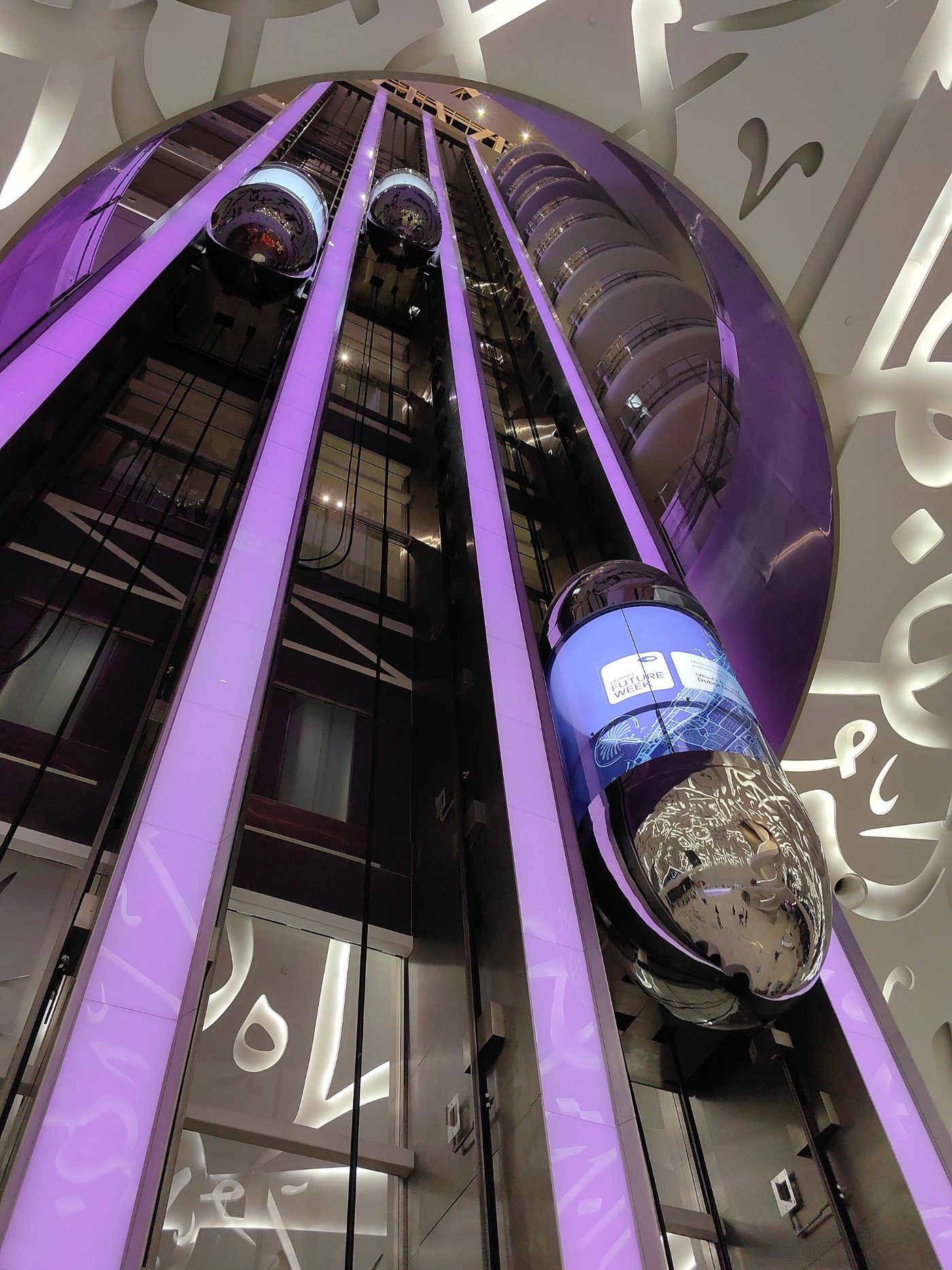
Inside, the building runs as a time machine. The lift ascends to the year 2071, the UAE's centenary, and the floors walk you back down toward today.1
- 05
OSS Hope
a space station 600 km above Earth, in the year 2071
- 04
HEAL Institute
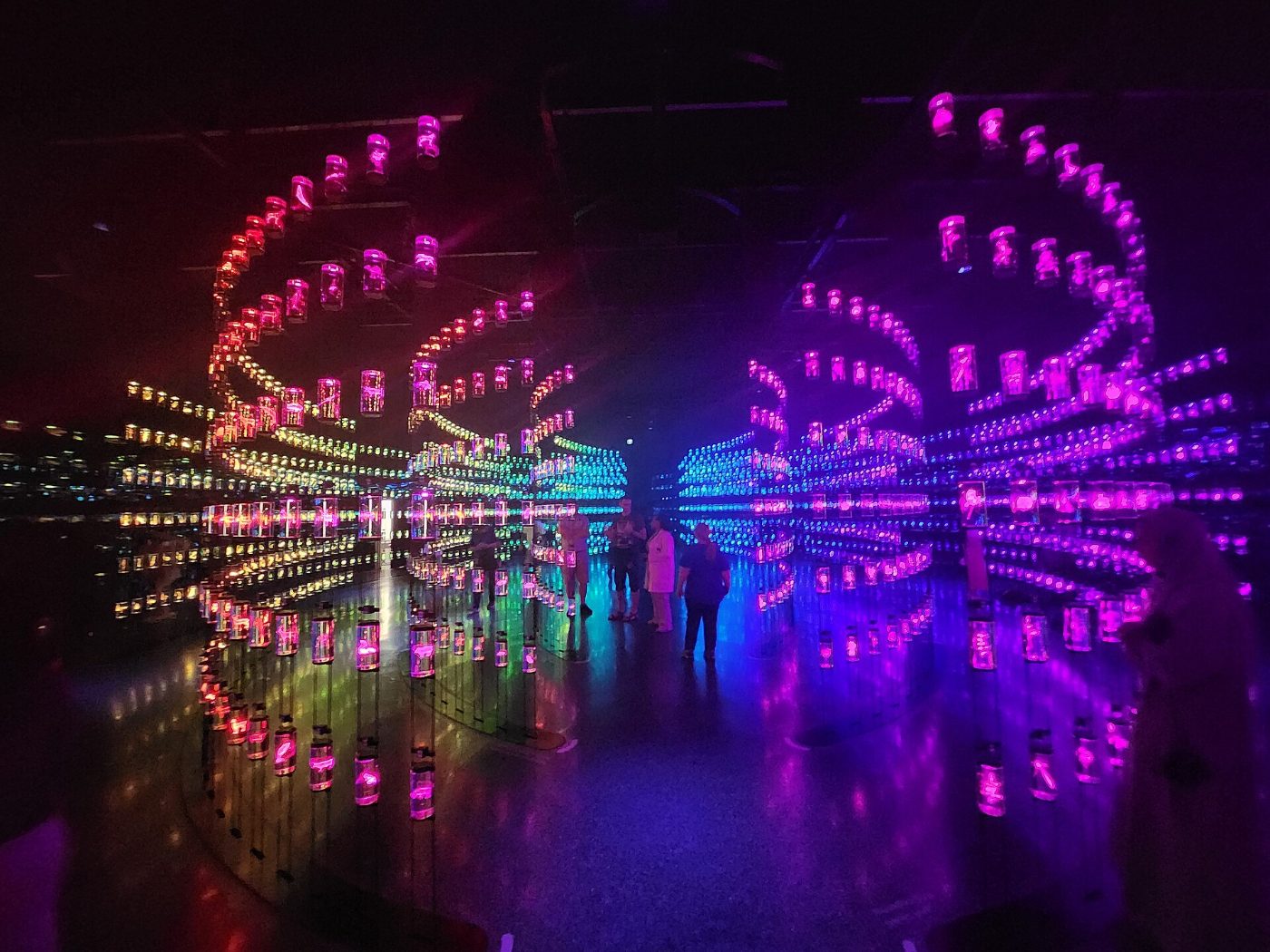
a digital Amazon and the Vault of Life, a DNA library of 2,400 species: the same number as the diagrid's steel members
- 03
Al Waha
a sensory oasis, the floor where the future slows down
- 02
Tomorrow Today
near-future technology you can already touch
- 01
Future Heroes
the children's floor: the visitors who will actually live there
Blueprint 06 · The curve
Five million people in four years
The building out-drew its own exhibitions: five million visitors by the fourth anniversary, from 163 countries in year one to 177 by year three. A ticket is AED 149.7
Blueprint 07 · The record
Sources
Every figure comes from the public record: the museum's own materials, the engineers' published accounts, and press releases. The 3D structure in the opening is a schematic diagrid drawn for this story, not engineering data.
- 01Museum of the Future · The Building (official)
- 02worldsteel / POSCO Newsroom · Museum of the Future pushes the boundaries of aesthetic design (diagrid growth algorithm)
- 03CompositesWorld · Building the Museum of the Future (1,024 panels, 16+ operations, 18-month installation)
- 04Dezeen · Killa Design's Museum of the Future wrapped in Arabic calligraphy (14 km of text, windows as glazing)
- 05Gulf News · What is written in Arabic on the exterior of Dubai's Museum of the Future
- 06Dubai Future Foundation · One million visitors from 163 countries in the first year
- 07Dubai Media Office · Museum of the Future receives 5 million visitors (Feb 2026)
- 08Gulf News · Dubai's Museum of the Future to close in September for major revamp (relaunch Q1 2027)
- 09Photography · Wikimedia Commons: EditQ (CC0), Александр Сигачёв, Saaremees (CC BY-SA 4.0)